Environmental Impact Beyond the Individual Life
Conversations about environmental impact often focus on daily habits and the choices made during a person’s lifetime. Energy use, transportation, food systems, and waste are common parts of that discussion. Less frequently considered is the environmental dimension that exists after a life has ended. Death, like every other part of the human experience, exists within natural systems and material processes. When viewed calmly and without urgency, it becomes possible to notice how the end of life also participates in broader environmental patterns.
Every society develops ways to care for the dead. These practices are shaped by culture, belief, geography, and available technology. At the same time, they interact with physical landscapes, resources, and infrastructure. Materials are used. Energy is consumed. Land is set aside for remembrance and burial. These elements often unfold quietly in the background of a community’s daily life, rarely discussed in environmental terms.

In places like California, where environmental awareness has become part of public conversation, there is sometimes curiosity about how end of life practices intersect with ecological systems. Cemeteries, crematories, memorial parks, and related spaces become part of the environmental landscape of a region. They share space with urban development, agricultural land, waterways, and natural habitats.
This relationship is not necessarily immediate or dramatic. Instead, it tends to exist through gradual interactions between human rituals and the material world. Over long periods of time, these interactions contribute to how land is used, how energy flows through infrastructure, and how communities think about continuity between generations.
Materials, Energy, and Landscape
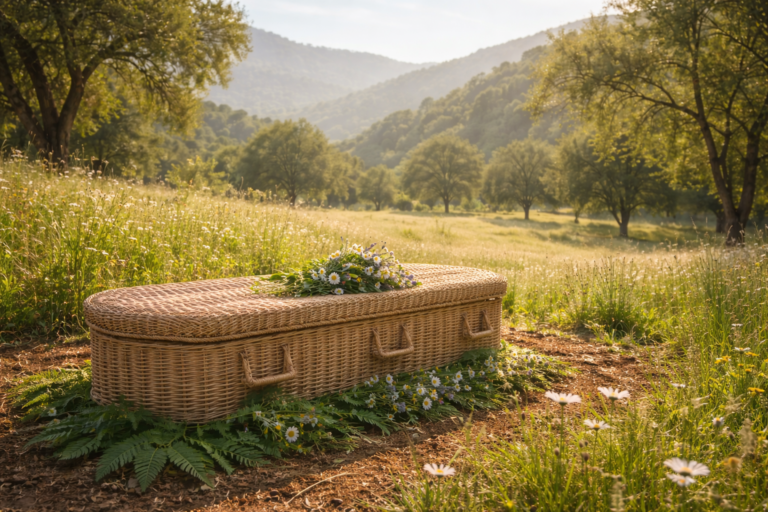
Traditional burial practices involve several physical components. Caskets are often constructed from wood, metal, or composite materials. Burial vaults and cemetery infrastructure may involve concrete and stone. Landscaped grounds require ongoing care, which can include irrigation, maintenance equipment, and long-term land management.
Cremation introduces a different set of material relationships. The process relies on controlled heat and specialized equipment designed to reduce a body to its basic mineral elements. This transformation requires energy, usually in the form of natural gas or electricity, depending on the facility and technology used.
These processes are rarely the center of environmental discussions, yet they remain part of the broader system of resource use within a community. Over time, researchers, planners, and environmental observers have become more interested in understanding how these practices fit into the wider picture of environmental stewardship and land management.
In California, where land availability, drought conditions, and population density shape many public conversations, cemeteries and cremation facilities sometimes appear within discussions about land use and infrastructure. These discussions are typically quiet and technical rather than emotional. They belong to the same category of planning considerations as water systems, transportation networks, and urban green spaces.
Cultural Continuity and Environmental Awareness
End of life traditions carry meaning that often extends far beyond environmental measurements. Ritual, remembrance, and cultural identity remain central to how communities approach death. For many families, the environmental dimension exists alongside these values rather than replacing them.
Over the past several decades, environmental awareness has gradually influenced how some people think about long term ecological relationships. This awareness does not necessarily lead to uniform conclusions. Instead, it often encourages a broader understanding of how human practices exist within natural cycles.
Death itself has always been part of ecological continuity. In natural environments, organic matter returns to soil, nutrients circulate, and landscapes evolve through gradual transformation. Human societies, with their ceremonies and infrastructure, participate in this cycle in more structured ways.
Looking at end of life practices through an environmental lens can therefore feel less like a dramatic shift and more like an expansion of perspective. It invites a slower reflection on how communities care for the dead while also existing within shared ecosystems.
In this sense, environmental impact beyond the individual life is not only about materials or energy. It also reflects how societies choose to place memory, land, and natural processes within the same long timeline.
ABOUT ANUBIS
Anubis Cremations serves families throughout California with a calm, transparent approach to end-of-life care. We focus on clarity, environmental responsibility, and respectful handling at every step, helping families navigate the practical and emotional decisions that come with loss.
Our goal is simple: to make a difficult time clearer, gentler, and easier to move through.
Learn more at https://anubiscremations.com
Call us 24/7 at 323-644-3323
info@anubiscremations.com